

Episode 243 - Stop Unfinished Work Following You Home
Sometimes it’s difficult to enjoy our time away from work even when we’ve finished for the day. New research shows that unfinished tasks and anticipating a busy day tomorrow can keep work active in our thinking while also reducing our motivation to engage with our leisure time. This episode looks at some practical ways to finish the working day well.
Summary
Sometimes it’s difficult to enjoy our time away from work even when we’ve finished for the day. New research shows that unfinished tasks and anticipating a busy day tomorrow can keep work active in our thinking while also reducing our motivation to engage with our leisure time. This episode looks at some practical ways to finish the working day well.
Transcript
Hello and welcome to episode 243 of the Leadership Today podcast, where each week we share practical tips to improve your leadership. This week we look at why unfinished work can follow us home and what we can do about it.
Most of us know what it’s like to finish work without really finishing work. We’ve physically finished up for the day, but part of our attention is still back there. Perhaps there’s something we didn’t quite get done, a problem we haven’t solved, or we’re already thinking about everything waiting for us tomorrow.
A new study followed 179 employees over 14 working days to explore how unfinished tasks and anticipated workload affect our leisure time. The researchers found two different processes at work.
The first process is probably quite familiar. When we have unfinished tasks or expect a heavy workload the following day, we’re more likely to continue thinking negatively about work. The working day might have finished, but mentally we’re still there.
The second process is called “motivation erosion”. This is when unfinished tasks and anticipated workload are also associated with people feeling less capable of fully engaging with and enjoying their leisure time.
So work doesn’t just follow us home through our thoughts. It can also reduce our motivation to make good use of the time we have away from work.
Imagine finishing at 5.30pm with three things you didn’t get done. You head home intending to go for a run, cook dinner or spend time with family. But you keep thinking about what you didn’t finish and what’s waiting for you tomorrow. By the time you get home, sitting on the couch and scrolling through your phone feels like the easiest option. You haven’t necessarily run out of time for leisure; you’ve lost some of your motivation to use that time well.
Here are three ways to avoid work following you home.
First, create a clearer ending to unfinished work. Before you finish for the day, write down exactly what still needs to be done and the next action you will take. Writing something like “finish report” leaves the task open in your mind. “Review the final two sections at 9am tomorrow” gives your brain a clearer plan for what happens next.
Second, be realistic about tomorrow. For participants in the research, anticipating a heavy workload was also associated with poorer leisure experiences. If tomorrow looks overwhelming, take a few minutes to identify what genuinely needs to happen and what can wait. Schedule the required time for each element into your calendar. Sometimes it’s the undefined sense of having too much to do that overwhelms us and follows us home.
Third, make some deliberate plans for your leisure time. If work can reduce our motivation to engage with life outside work, don’t rely entirely on how you feel at the end of the day. Arrange the walk, book the exercise class, plan dinner with someone or decide what you’re going to do before you finish work.
Bringing all of this together, finishing work well is partly about creating a clear psychological ending to the working day and also about planning our leisure well. So before you finish today, ask yourself: “What do I need to write down or decide now so I don’t have to keep carrying this tonight?” Then take some time to plan your downtime.
Reference
Rutten, R. L. J., & Wehrt, W. (2026). Leisure under lock: cognitive activation and motivation erosion as mechanisms undermining experiential quality of leisure time. Work & Stress. https://doi.org/10.1080/02678373.2026.2722069
Leadership Today On-Demand Special Offer
We have a great deal for podcast listeners on our Leadership Today On-Demand subscription. Just go to www.leadershiptoday.com and checkout using the promo code PODCAST for 25% off an annual subscription.
Leadership Today On-Demand is a video subscription service that allows you to work on your leadership in your own time and at your own pace. It is available online and through our Apple iOS and Android apps for phones and tablets. Our mission is to help you to become an even better leader.
Your subscription brings together all of our video content in one place including:
- Five online courses with workbooks
- Five five day challenges with workbooks
- Nineteen recorded webinars
- A searchable library of 170+ "how to" quick videos on a range of leadership challenges
That's over $4,500 of content for less than the price of a single online course. And there are more videos added each week.
Get Connected
Find out ways to get connected here: https://leadership.today/connect

Episode 242 - How to Give People Autonomy When There Isn’t Much Freedom
Autonomy matters for motivation, but what happens when people work in a highly structured environment with lots of rules? New research involving nearly 3,900 NSW Police Force personnel shows that autonomy can still be supported within clear boundaries. This episode looks at how leaders can provide more ownership without removing necessary structure.
Summary
Autonomy matters for motivation, but what happens when people work in a highly structured environment with lots of rules? New research involving nearly 3,900 NSW Police Force personnel shows that autonomy can still be supported within clear boundaries. This episode looks at how leaders can provide more ownership without removing necessary structure.
Transcript
Hello and welcome to episode 242 of the Leadership Today podcast, where each week we share practical tips to improve your leadership. This week we’re looking at autonomy and a question that often comes up in highly structured workplaces: what do you do when there really isn’t much choice?
Self-Determination Theory identifies autonomy as one of three basic psychological needs, alongside competence and relatedness. When we experience some ownership and choice over our actions, our motivation and wellbeing tend to be stronger. But what happens when you work somewhere with lots of rules?
Think about healthcare, emergency services, government, aviation or policing. There are policies, procedures, legal requirements and standards that simply have to be followed. A leader can’t just say, “Do whatever feels right to you.”
So does autonomy still matter in those environments?
A new study involving nearly 3,900 people in the NSW Police Force suggests it does. The researchers found that organisational support was associated with greater satisfaction of people’s needs for autonomy, competence and relatedness, along with better outcomes such as commitment and wellbeing. Workplace conflict, on the other hand, was associated with greater frustration of those needs and poorer outcomes. But perhaps the most useful finding for leaders was that people could still experience autonomy in a highly structured command-and-control environment.
The catch is that autonomy doesn’t mean independence or complete freedom. It’s more about having some sense of ownership over what you’re doing. You might have no choice about whether a safety procedure needs to be followed. But there may still be flexibility in how work is organised around that requirement. People might be able to contribute ideas about implementation. They may have discretion within clear boundaries.
Here are three ideas to try.
First, explain the rationale. Sometimes leaders say, “That’s just the policy”, and technically that might be correct. But where you can, explain why the requirement exists. It’s easier to accept a constraint when you understand the reason behind it.
Second, be clear about where choice exists and where it doesn’t. You might say, “We have to achieve this outcome and these two requirements aren’t negotiable, but you have quite a bit of flexibility around the rest.” That’s much more helpful than either pretending people have complete freedom or controlling everything unnecessarily.
Third, involve people in the things they can genuinely influence. A team may not be able to remove a mandatory process, but they might be able to improve how it’s scheduled, how information is shared or how work is handed over. Those smaller areas of influence still matter.
There’s one other useful aspect of the research. The researchers distinguished between a need not being fully satisfied and a need being actively frustrated. Those aren’t quite the same thing. You might have a job where there isn’t much autonomy, but you don’t necessarily feel controlled. That’s different from an environment where you’re constantly being pressured, micromanaged or prevented from exercising reasonable judgement. In leadership, sometimes you can’t increase choice very much. But you can still avoid making things more controlling than they need to be.
Bringing all of this together, the key question isn’t, “Can I let people do whatever they want?” It’s, “Where can I provide ownership, rationale and discretion within the boundaries we genuinely need?”
Reference
Marsh, H. W., Ryan, R. M., Craven, R. G., Dicke, T., Guo, J., & Parker, P. D. (2026). Workplace demands/resources, basic psychological needs, and police well-being: an extended integration of self-determination theory and job demands–resources models. Current Psychology, 45, Article 1464. https://doi.org/10.1007/s12144-026-10005-y.
Leadership Today On-Demand Special Offer
We have a great deal for podcast listeners on our Leadership Today On-Demand subscription. Just go to www.leadershiptoday.com and checkout using the promo code PODCAST for 25% off an annual subscription.
Leadership Today On-Demand is a video subscription service that allows you to work on your leadership in your own time and at your own pace. It is available online and through our Apple iOS and Android apps for phones and tablets. Our mission is to help you to become an even better leader.
Your subscription brings together all of our video content in one place including:
- Five online courses with workbooks
- Five five day challenges with workbooks
- Nineteen recorded webinars
- A searchable library of 170+ "how to" quick videos on a range of leadership challenges
That's over $4,500 of content for less than the price of a single online course. And there are more videos added each week.
Get Connected
Find out ways to get connected here: https://leadership.today/connect

Episode 241 - Curiosity is Productive Inefficiency
We often treat efficiency as an unquestioned good, but curiosity works differently. A major new research review describes curiosity as "productive inefficiency", slowing us down in the short term while helping us find better ideas and solutions. This episode looks at where leaders should deliberately make room for curiosity.
Summary
We often treat efficiency as an unquestioned good, but curiosity works differently. A major new research review describes curiosity as "productive inefficiency", slowing us down in the short term while helping us find better ideas and solutions. This episode looks at where leaders should deliberately make room for curiosity.
Transcript
Hello and welcome to episode 241 of the Leadership Today podcast, where each week we share practical tips to improve your leadership. This week we look at curiosity and why being less efficient can sometimes help us produce better work.
Most organisations are trying to become more efficient. We want shorter meetings, faster decisions, streamlined processes and fewer wasted hours. As leaders, we're often trying to help people get to the answer more quickly. But we’re also wanting people to demonstrate greater curiosity, which works in almost the opposite direction.
A major new review of research into curiosity at work describes curiosity as a form of "productive inefficiency". When we're curious, we tend to slow things down. We ask another question, we look at an issue from another perspective, and we might even explore an option that ultimately leads nowhere. Instead of accepting the first reasonable answer, we spend a little longer wondering whether there might be a better one.
In the short term, that's inefficient. But the researchers argue that this apparent inefficiency can contribute to things like creativity, adaptability and better solutions over time. The catch is we're often trying to encourage curiosity while simultaneously removing the space it requires.
Imagine someone brings you a problem. You know what they should do, so you give them the answer. That's efficient. The problem disappears and both of you can move on. Compare that with asking, "What do you think is causing the problem?" or "What options have you considered?" That takes longer. They may suggest ideas that aren't particularly good. You might end up at exactly the same solution you would have given them five minutes earlier. But something different has happened. They've had to think about the problem rather than simply receive your answer. And perhaps they've noticed something you hadn't considered.
The same thing happens in meetings. We can become so focused on getting through the agenda that questions start to feel like interruptions. Someone says, "I wonder why we still do it this way?" and the response is, "That's a bigger conversation. Let's take that offline." Now sometimes that's exactly the right response. We can't explore every interesting question that comes up. That's another important part of this research. The authors aren't suggesting that curiosity is always good or that we should maximise it. Curiosity consumes time and attention. Instead, it’s more useful to think about where curiosity is worth the cost.
Here are three things I'd suggest.
First, identify the work where you don't want the quickest answer. If you're dealing with a complex problem, making an important decision or trying to improve something that hasn't been working, deliberately allow more time for questions and alternatives. That's where a little inefficiency may pay off.
Second, notice how you respond when people are curious. Leaders can say they want people to challenge the status quo while unintentionally shutting down questions through impatience. If every curious question receives a quick explanation of why things can't change, people eventually stop asking.
Third, put some boundaries around curiosity. You might spend the first 15 minutes of a discussion exploring the problem without trying to solve it. Or ask everyone to come up with three different explanations before deciding what is going on. The aim isn't endless exploration. It's making sure efficiency doesn't close down thinking too early.
Bringing all of this together, the key question isn't, "How can we make everything more efficient?" A better question might be, "Where would a little inefficiency help us think better?"
Reference
Kashdan, T. B., McKnight, P. E., & Harrison, S. H. (2026). Curiosity at Work: A Productive Inefficiency Model. Annual Review of Organizational Psychology and Organizational Behavior, 14. https://doi.org/10.1146/annurev-orgpsych-012825-104832.
Leadership Today On-Demand Special Offer
We have a great deal for podcast listeners on our Leadership Today On-Demand subscription. Just go to www.leadershiptoday.com and checkout using the promo code PODCAST for 25% off an annual subscription.
Leadership Today On-Demand is a video subscription service that allows you to work on your leadership in your own time and at your own pace. It is available online and through our Apple iOS and Android apps for phones and tablets. Our mission is to help you to become an even better leader.
Your subscription brings together all of our video content in one place including:
- Five online courses with workbooks
- Five five day challenges with workbooks
- Nineteen recorded webinars
- A searchable library of 170+ "how to" quick videos on a range of leadership challenges
That's over $4,500 of content for less than the price of a single online course. And there are more videos added each week.
Get Connected
Find out ways to get connected here: https://leadership.today/connect

Episode 240 - When Negative Feedback Becomes Too Much
Negative feedback can sometimes improve performance and sometimes leave people distracted, discouraged or withdrawing from their work. New research shows that how surprising, disruptive and consequential the feedback feels helps explain those different reactions. This episode looks at how leaders can make difficult feedback clearer and easier to act on.
Summary
Negative feedback can sometimes improve performance and sometimes leave people distracted, discouraged or withdrawing from their work. New research shows that how surprising, disruptive and consequential the feedback feels helps explain those different reactions. This episode looks at how leaders can make difficult feedback clearer and easier to act on.
Transcript
Hello and welcome to episode 240 of the Leadership Today podcast, where each week we share practical tips to improve your leadership. This week we look at negative feedback and why the way someone experiences the feedback can matter just as much as what you actually say.
Most leaders know that feedback needs to be clear and specific. If something isn't working, we need to talk about it rather than hoping the problem fixes itself. But we've probably also experienced situations where feedback seems to have a much bigger impact than we expected. We raise what feels like a fairly straightforward issue and the person becomes defensive, discouraged or distracted by it for days afterwards.
New research published in Human Resource Management helps explain why. Rather than treating every piece of negative feedback as the same, the researchers looked at specific feedback events over a 10-week period. They were particularly interested in how novel, disruptive and critical the feedback felt to the employee.
By way of example, imagine telling someone they need to tighten up the formatting in a report. That's negative feedback, but it probably isn't particularly surprising or consequential. Now imagine telling someone who believes they are performing well that there are serious concerns about their overall performance. That's a very different event, even if both conversations could technically be described as negative feedback.
The research suggests these characteristics matter because feedback can affect our sense of competence and use up mental resources. If the feedback is significant enough, part of the person's attention shifts away from the work itself and towards trying to understand what has happened, what it means and what they need to do next.
For leaders, one implication is to think beyond the message you are delivering and consider how surprising it will be. If someone has been hearing nothing but positive comments for six months and then receives a major performance concern at their annual review, the novelty of that information becomes part of the problem. Regular, proportionate feedback reduces the likelihood that one conversation has to carry everything.
It's also worth thinking about how disruptive the feedback is. Are you asking the person to make one specific adjustment, or are you effectively telling them that their whole approach needs to change? When substantial change is required, people may need help breaking that into manageable steps rather than leaving the meeting with a broad sense that everything is wrong.
And then there's the issue of competence. Corrective feedback should focus on the approach someone is taking rather than who they are as a person. Something like, “This part isn't yet at the standard we need, so let's work through what needs to change”, gives you room to be clear about the problem while still conveying confidence that improvement is possible.
This doesn't mean cushioning every difficult message or turning negative feedback into praise. Sometimes the feedback genuinely is serious and needs to sound serious. But it does mean recognising that the same words can land very differently depending on what the employee already believes, how consequential the issue is and how much change you're asking them to make.
One question worth asking before your next difficult feedback conversation is: How big an event is this likely to be for the other person? If the answer is “quite a big one”, then allow enough time not just to deliver the feedback, but also to help them make sense of it and work out what happens next.
Clear feedback matters. But effective feedback conversations also take into account the impact of the message on the person.
Reference
Corwin, E. S., Rosen, C. C., Lee, H. W., Simon, L. S., & Johnson, R. E. (2026). Negative Feedback as Performance Conversations: An Event Systems Perspective. Human Resource Management. Advance online publication. https://doi.org/10.1002/hrm.70094.
Leadership Today On-Demand Special Offer
We have a great deal for podcast listeners on our Leadership Today On-Demand subscription. Just go to www.leadershiptoday.com and checkout using the promo code PODCAST for 25% off an annual subscription.
Leadership Today On-Demand is a video subscription service that allows you to work on your leadership in your own time and at your own pace. It is available online and through our Apple iOS and Android apps for phones and tablets. Our mission is to help you to become an even better leader.
Your subscription brings together all of our video content in one place including:
- Five online courses with workbooks
- Five five day challenges with workbooks
- Nineteen recorded webinars
- A searchable library of 170+ "how to" quick videos on a range of leadership challenges
That's over $4,500 of content for less than the price of a single online course. And there are more videos added each week.
Get Connected
Find out ways to get connected here: https://leadership.today/connect

Episode 239 - Does Your Team Think the Relationship is as Good as You Do?
Leaders can easily assume they have stronger relationships with employees than employees themselves experience. New research shows that this mismatch can reduce psychological safety and make people less likely to speak up. This episode looks at how leaders can test their assumptions and make it easier for people to raise concerns.
Summary
Leaders can easily assume they have stronger relationships with employees than employees themselves experience. New research shows that this mismatch can reduce psychological safety and make people less likely to speak up. This episode looks at how leaders can test their assumptions and make it easier for people to raise concerns.
Transcript
Hello and welcome to episode 239 of the Leadership Today podcast, where each week we share practical tips to improve your leadership. This week we look at how leaders and their teams rate the quality of their relationships, and the impact on whether people feel confident to speak up.
Most leaders think they have a pretty clear view about the relationships they have with people in their team. The problem is that relationships involve two people, and the other person may not see things in quite the same way. A recent study looked at leader-member relationships from both sides. The researchers collected data from 496 employees and 139 leaders and examined how closely leaders and employees agreed about the quality of their relationship. They then looked at psychological safety and whether employees were willing to speak up with ideas, concerns and suggestions.
As you might expect, relationships were strongest when both the leader and employee saw them positively. But the more interesting finding was what happened when the leader rated the relationship more positively than the employee did. In those situations, psychological safety was particularly low. Leaders can easily overestimate how safe they are to talk to. We know our own intentions. We know that we want people to raise concerns and challenge our thinking. But employees are making a different judgement. They’re trying to work out what is likely to happen if they disagree, raise a problem or tell us something we don’t really want to hear.
A leader might think, “My door is always open”, while an employee is thinking, “Yes, but I’m not sure how they’ll respond if I tell them the project isn’t working”. Those two people are describing the same relationship very differently.
The challenge is that leaders who think the relationship is already strong may not do much to improve it. If someone rarely disagrees with us, we can interpret that as evidence that everything is going well, when it may simply mean they’re being cautious.
One useful thing to do is look for behavioural evidence rather than relying on your own sense of the relationship. Does the person ever disagree with you? Do they bring you bad news early? Do they raise concerns before they become problems? Do they offer a different view when you’ve already expressed a preference?
You can also make it easier for people to tell you how the relationship is working for them. Rather than asking, “Is everything okay?”, which will usually produce “yes”, try something more specific. You might ask, “What could I do that would make it easier for you to raise concerns with me?” or “Is there anything I do that makes it harder for you to disagree?”
Of course, asking the question is only useful if you respond well to the answer. If someone takes a risk and gives you feedback, becoming defensive teaches them something very quickly about how safe the relationship really is.
Leaders don’t get to decide on their own whether a relationship is strong. What matters is how both people experience it.
So this week, think about someone in your team you believe you have a very good relationship with. Then ask yourself a slightly uncomfortable question: what evidence do I have that they would describe it the same way?
Thanks for listening, and I look forward to speaking with you again next week.
Research:
Pahng, P. H., Fuller, R., Kwak, J. S., & Kang, S. M. (2026). Same Playbook, Safer Plays: Leader-Member Alignment and Employee Voice. International Journal of Business Communication. Advance online publication. https://doi.org/10.1177/23294884261476053
Leadership Today On-Demand Special Offer
We have a great deal for podcast listeners on our Leadership Today On-Demand subscription. Just go to www.leadershiptoday.com and checkout using the promo code PODCAST for 25% off an annual subscription.
Leadership Today On-Demand is a video subscription service that allows you to work on your leadership in your own time and at your own pace. It is available online and through our Apple iOS and Android apps for phones and tablets. Our mission is to help you to become an even better leader.
Your subscription brings together all of our video content in one place including:
- Five online courses with workbooks
- Five five day challenges with workbooks
- Nineteen recorded webinars
- A searchable library of 170+ "how to" quick videos on a range of leadership challenges
That's over $4,500 of content for less than the price of a single online course. And there are more videos added each week.
Get Connected
Find out ways to get connected here: https://leadership.today/connect
Interview - Dr Gleb Tsipursky - Helping Teams Embrace AI
In this episode, Andrew Beveridge speaks with behavioural scientist and author Dr Gleb Tsipursky about why successful AI adoption depends as much on psychology and leadership as it does on technology. Gleb identifies three key barriers - fear of job loss, threats to professional identity, and the stigma associated with using AI - and offers practical ways leaders can build trust, establish clear guardrails, provide tailored training, and begin with repetitive tasks employees would gladly give up. They also explore the emergence of “shadow AI,” the importance of leaders role-modelling responsible use, and a future in which employees increasingly manage and evaluate AI agents. Drawing on examples from his book, The Psychology of AI Adoption at Work, Gleb presents an evidence-informed and ultimately optimistic approach to helping organisations turn resistance into meaningful results.
AI adoption isn’t just a technology challenge - it’s a leadership and psychology challenge.
In this episode of Leadership Today, Andrew Beveridge speaks with behavioural scientist, author and CEO of Disaster Avoidance Experts, Dr Gleb Tsipursky. Drawing on his new book, The Psychology of AI Adoption at Work: From Resistance to Results, Gleb explains why many AI initiatives fail to deliver a return and what leaders can do differently.
They explore the three emotional barriers that often hold employees back: fear of job loss, threats to professional identity, and the social stigma associated with using AI. Gleb shares practical ways to respond, from giving people greater clarity about job security and beginning with tasks they dislike, to role-modelling responsible AI use, providing tailored training, and creating safe spaces for employees to share what is working.
The conversation also looks ahead to a workplace where people increasingly manage teams of AI agents. Andrew and Gleb discuss how this shift could reshape roles, career pathways and leadership - and why skills such as critical evaluation, editing, agent management and sound judgement will become even more valuable.
In this episode:
- Why focusing on technology alone leads many AI initiatives off track
- The three psychological barriers to AI adoption
- How leaders can reduce fear and resistance while building trust
- Why starting with frustrating, repetitive tasks can create momentum
- How role-modelling, training and shared learning can reduce “shadow AI”
- The role of governance and clear guardrails in enabling faster adoption
- Why employees may become managers of AI agents
- How AI could reshape organisational structures and future career paths
- Practical examples of using AI to improve both efficiency and effectiveness
If you’re leading AI adoption - or trying to help your team engage with it more confidently - this episode offers an evidence-informed and practical place to start.
You can find out more about Dr Gleb Tsipursky's new book here: https://disasteravoidanceexperts.com/aibook/
You can purchase the book via Amazon here: https://www.amazon.com/Psychology-AI-Adoption-Work-Resistance
Learn more about Dr Gleb Tsipursky here: https://disasteravoidanceexperts.com
00:00 — Introduction
02:34 — Gleb’s background and interest in decision-making
04:43 — Why organisational AI initiatives go wrong
08:10 — The three emotional barriers to AI adoption
14:33 — Reducing employees’ fear of job loss
18:22 — Responding to professional identity threats
24:25 — Tackling shame and “shadow AI”
27:50 — Training and shared learning
30:36 — Governance and clear guardrails
32:01 — How AI may reshape organisational structures
34:30 — Employees as managers of AI agents
38:23 — AI, robotics, and physical work
42:06 — Building workflows with multiple AI agents
47:39 — Measuring efficiency and effectiveness
51:17 — Further resources and the book
53:17 — Final leadership takeaways

Episode 238 - Remember What It Was Like to Be a Beginner
The better we become at something, the harder it can be to remember what it was like not to know. New research shows that experts give more useful and actionable advice when they reconnect with their own experience as beginners. This episode explores a simple way leaders can become better coaches and teachers.
Summary
The better we become at something, the harder it can be to remember what it was like not to know. New research shows that experts give more useful and actionable advice when they reconnect with their own experience as beginners. This episode explores a simple way leaders can become better coaches and teachers.
Transcript
Hello and welcome to episode 238 of the Leadership Today podcast, where each week we share practical tips to improve your leadership. This week we look at a challenge that comes with becoming more experienced: the better we become at something, the harder it can be to explain it to someone who's just starting out.
Think about something you've done hundreds or perhaps thousands of times. It might be running a meeting, preparing a report, handling a difficult customer, using a particular system or having a performance conversation. After enough practice, many of the steps become almost automatic. You don't consciously think about everything you're doing because you've built up knowledge and patterns that allow you to work quickly.
That's usually a good thing, but it creates a challenge when someone less experienced asks us for advice. We can forget what it was like not to know what we now know.
A new study published in the Academy of Management Journal explores this problem. The research looked at what happens when experts reconnect with what they call a beginner's mind. Rather than simply remembering an event from the past, people were encouraged to mentally revisit what it actually felt like to be a novice in that particular area.
Across studies involving managers and musicians, taking on a beginner’s mind made a difference to the advice experts provided. When experienced people reconnected with their former beginner state, their advice became more concrete. And importantly, the novices receiving that advice rated it as more useful and were more willing to act on it.
It helps explain something we see constantly at work. An experienced leader might tell a new supervisor, "You just need to have a clear conversation and hold them accountable." That sounds perfectly sensible to someone who has handled dozens of performance conversations. But the new leader may still be wondering: How do I actually start the conversation? What words do I use? What happens if they become defensive? What should I prepare beforehand?
Expertise compresses all of those little steps. Once something feels obvious to us, we stop mentioning the things that no longer require conscious thought.
That's why telling someone to "communicate more effectively", "delegate properly" or "think strategically" often isn't particularly helpful. The advice describes the destination without helping the person with the journey.
There are three practical ways leaders can use this research.
First, before giving advice, briefly remember your own first attempt. Think back to when you genuinely didn't know what to do. What were you worried about? What confused you? What did you misunderstand? What would you have wanted someone to tell you at that point? That mental exercise may help you notice assumptions that your expertise now hides from you.
Second, make your advice behavioural. Instead of saying, "You need to delegate more", describe what the person could actually do. You might say, "Choose one task this week, explain the outcome you're looking for, ask the person how they would approach it, agree when you'll check in, and resist taking the task back unless there's a genuine risk." Concrete advice is easier to act on.
Third, check what the other person already knows. Before launching into an explanation, ask, "What have you tried so far?" or "Talk me through how you'd approach it." That helps you pitch your advice at the right level and also encourages the other person to think rather than simply waiting for your answer.
Expertise doesn't automatically make us good teachers or coaches. In fact, expertise can sometimes get in the way because it makes the difficult look obvious. Great leaders benefit from traveling back to their own beginning so they can help someone else move forward.
Reference
Zhang, T. (2026). Back to the beginning: Rediscovering a beginner's mind enhances advice provision to novices. Academy of Management Journal. Advance online publication. https://doi.org/10.5465/amj.2023.0816.
Leadership Today On-Demand Special Offer
We have a great deal for podcast listeners on our Leadership Today On-Demand subscription. Just go to www.leadershiptoday.com and checkout using the promo code PODCAST for 25% off an annual subscription.
Leadership Today On-Demand is a video subscription service that allows you to work on your leadership in your own time and at your own pace. It is available online and through our Apple iOS and Android apps for phones and tablets. Our mission is to help you to become an even better leader.
Your subscription brings together all of our video content in one place including:
- Five online courses with workbooks
- Five five day challenges with workbooks
- Nineteen recorded webinars
- A searchable library of 170+ "how to" quick videos on a range of leadership challenges
That's over $4,500 of content for less than the price of a single online course. And there are more videos added each week.
Get Connected
Find out ways to get connected here: https://leadership.today/connect

Episode 237 - The Hidden Bias in Performance Reviews
Some employees are especially good at adapting their behaviour and creating positive impressions, but does that mean they actually perform better? A new meta-analysis suggests self-monitoring predicts supervisor performance ratings more than objective performance outcomes. This episode explores how leaders can distinguish genuine contribution from the appearance of performance.
Summary
Some employees are especially good at adapting their behaviour and creating positive impressions, but does that mean they actually perform better? A new meta-analysis suggests self-monitoring predicts supervisor performance ratings more than objective performance outcomes. This episode explores how leaders can distinguish genuine contribution from the appearance of performance.
Transcript
Hello and welcome to episode 237 of the Leadership Today podcast, where each week we share practical tips to improve your leadership. This week we look at a subtle bias that can influence performance reviews: confusing someone's ability to manage impressions with their actual performance.
Some people are naturally very good at reading a room. They notice what other people expect, adapt how they present themselves and adjust their behaviour to fit different situations. Psychologists call this self-monitoring.
High self-monitors are socially skilled. They recognise when to speak up, when to hold back and how to present their contribution in a way that resonates with different people. Those can all be useful capabilities at work.
For years, research has suggested that self-monitoring is also associated with job performance. But a new meta-analysis asks an interesting question: are high self-monitors actually performing better, or are they simply better at being seen as high performers?
The researchers analysed 35 samples and found a modest overall relationship between self-monitoring and job performance. But when they examined how performance was measured, they found that the relationship appeared when supervisors rated performance, but not when performance was assessed using more objective outcome measures. This indicates that at least part of the apparent performance advantage comes from influencing the person doing the rating rather than actual performance.
Most workplaces don't measure performance perfectly. Leaders form impressions based on conversations, meetings, presentations, emails and the things they happen to observe. Employees who are skilled at recognising what the manager values may naturally become more visible in those settings. Meanwhile, another employee may quietly produce excellent work without drawing much attention to it.
The danger is that we start treating visibility as performance. Someone who speaks confidently in meetings can appear more capable than someone whose contribution is less visible. Someone who regularly updates the boss can appear more productive than someone who simply gets the work done.
There are three practical ways leaders can reduce this bias.
First, define performance before evaluating the person. Be clear about the results, behaviours and standards that matter for the role. It's much easier for impressions to take over when performance expectations are vague.
Second, use multiple sources of evidence. Look at outcomes, feedback from others, customer impact and observable contribution rather than relying solely on your overall impression. Ask yourself, “What evidence would I use to explain this rating to someone who has never met this employee?”
Third, look for invisible contribution. Who solves problems quietly? Who helps colleagues without drawing attention to it? Who consistently produces reliable work but rarely talks about it? Strong performance isn't always highly visible.
This doesn't mean socially skilled employees are intentionally manipulating leaders to receive a more favourable performance evaluation. However, we need to be careful not to allow presentation skills to substitute for evidence when evaluating performance.
Performance and the appearance of performance are not the same thing. Great leaders don't ignore impressions, but they make sure those impressions are tested against evidence.
Reference
Moser, K., Ebner, K., Iliescu, D., & Sîrbu, A.-A. (2026). Self-monitoring and job performance: Substance or style? A meta-analysis. Journal of Occupational and Organizational Psychology.
Leadership Today On-Demand Special Offer
We have a great deal for podcast listeners on our Leadership Today On-Demand subscription. Just go to www.leadershiptoday.com and checkout using the promo code PODCAST for 25% off an annual subscription.
Leadership Today On-Demand is a video subscription service that allows you to work on your leadership in your own time and at your own pace. It is available online and through our Apple iOS and Android apps for phones and tablets. Our mission is to help you to become an even better leader.
Your subscription brings together all of our video content in one place including:
- Five online courses with workbooks
- Five five day challenges with workbooks
- Nineteen recorded webinars
- A searchable library of 170+ "how to" quick videos on a range of leadership challenges
That's over $4,500 of content for less than the price of a single online course. And there are more videos added each week.
Get Connected
Find out ways to get connected here: https://leadership.today/connect

Episode 236 - The Go-To Person Trap
Every team seems to have someone everybody goes to for help. New research shows that leaders may unintentionally create these go-to employees through the people they visibly rely on, increasing burnout without necessarily improving performance ratings. Discover how to spread expertise without exhausting your most dependable people.
Summary
Every team seems to have someone everybody goes to for help. New research shows that leaders may unintentionally create these go-to employees through the people they visibly rely on, increasing burnout without necessarily improving performance ratings. Discover how to spread expertise without exhausting your most dependable people.
Transcript
Hello and welcome to the Leadership Today podcast, where each week we share practical tips to improve your leadership. This week we look at how the person everyone relies on can gradually become overloaded, and what to do about it.
Most teams have a go-to person. They’re the colleague people approach when they are unsure what to do, when something needs fixing, or when a deadline is approaching. They know how things work, they are reliable, and they are usually generous with their time. Having someone like that in a team can seem like an enormous advantage,
but new research suggests there may be a hidden cost.
The researchers began with an interesting question. When someone needs help at work, how do they decide who to approach? We might assume that people carefully consider who has the right expertise for the particular problem. Sometimes they probably do. But that requires knowledge and effort, and often we use shortcuts instead.
One shortcut appears to be looking at who the leader relies on. If the manager regularly goes to one particular person for advice, information or assistance, other team members notice. They infer that this person must be knowledgeable, capable and safe to approach. The researchers describe this as an “imitate-the-successful” shortcut. Rather than asking, “Who is best qualified to help me with this particular problem?”, people effectively ask, “Who does the boss go to?”
Over time, those individual decisions accumulate. The same employee receives more questions, more requests for advice and more interruptions. Eventually, they become the unofficial go-to person for an increasingly broad range of issues.
There is obviously an upside. Being trusted and relied upon can be rewarding. It can indicate expertise and provide opportunities to contribute beyond the formal boundaries of a role. But the research also identified an important downside. Go-to employees experienced greater burnout without necessarily receiving higher performance ratings as a result.
That creates a real leadership risk. Some of our most capable people may be doing a large amount of invisible work that never appears in their position description or performance measures. Each individual request may only take five or ten minutes, but collectively those interruptions can consume a significant part of the working week.
The irony is that leaders may contribute to the pattern because they trust the person. We rely on them because they are capable, and our visible reliance signals to everyone else that they should do the same. The reward for being reliable becomes even more work.
There are three practical things leaders can do.
First, notice where the requests are going. Ask yourself who people approach when they are stuck. You can also ask your team where they go for different kinds of help. If one name appears repeatedly across unrelated areas, you may have developed a dependency rather than simply recognising expertise.
Second, distribute expertise deliberately. Instead of always approaching the same trusted employee, involve other people and make their expertise visible. You might say, “Sarah knows this process really well, so speak with her about that,” or ask different team members to lead particular areas. The goal is to create several places people can go rather than one human help desk.
Third, recognise helping as real work. If someone is regularly supporting colleagues, factor that into their workload and performance conversations. Do not give them a full individual workload and then treat all of the helping as something they should somehow squeeze in around the edges.
There is also a useful question you can ask your go-to person: “How much of your week is spent helping other people get their work done?” The answer may surprise you.
The key takeaway is that becoming the person everyone trusts can look like success while quietly becoming a source of overload. Great leaders build capability across the team rather than allowing dependence to accumulate around one highly capable person.
So take a look at your team this week. Who has become the person everyone goes to? And perhaps more importantly, what are you doing as the leader that might be reinforcing that pattern?
Thanks for listening, and I look forward to speaking with you again next week.
Reference
Frank, E. L., Matta, F. K., Nakos, O. M., & Rodell, J. B. (2026). How the boss’s “right hand” becomes the group’s “go-to”: Leader–member exchange as a heuristic cue for everyday asks. Journal of Applied Psychology. https://doi.org/10.1037/apl0001401
Leadership Today On-Demand Special Offer
We have a great deal for podcast listeners on our Leadership Today On-Demand subscription. Just go to www.leadershiptoday.com and checkout using the promo code PODCAST for 25% off an annual subscription.
Leadership Today On-Demand is a video subscription service that allows you to work on your leadership in your own time and at your own pace. It is available online and through our Apple iOS and Android apps for phones and tablets. Our mission is to help you to become an even better leader.
Your subscription brings together all of our video content in one place including:
- Five online courses with workbooks
- Five five day challenges with workbooks
- Nineteen recorded webinars
- A searchable library of 170+ "how to" quick videos on a range of leadership challenges
That's over $4,500 of content for less than the price of a single online course. And there are more videos added each week.
Get Connected
Find out ways to get connected here: https://leadership.today/connect

Episode 235 - How to Help Your Team Feel Heard
Most leaders understand the importance of listening, but far fewer understand what great listening actually looks like. Discover the research behind high-quality listening and why helping people feel genuinely heard can improve trust, engagement, wellbeing, and retention.
Summary
Most leaders understand the importance of listening, but far fewer understand what great listening actually looks like. Discover the research behind high-quality listening and why helping people feel genuinely heard can improve trust, engagement, wellbeing, and retention.
Transcript
Hello and welcome to episode 235 of the Leadership Today podcast, where each week we share practical tips to improve your leadership. This week we explore the research behind high-quality listening and why helping people feel genuinely heard can improve trust, engagement, wellbeing, and retention.
Most leaders would agree that listening is important. In fact, if you ask people to describe the best leaders they’ve worked with, listening often appears near the top of the list. And yet, listening is one of those skills that can be easy to talk about and surprisingly difficult to do well.
Part of the challenge is that we often think of listening as a communication technique. We focus on maintaining eye contact, nodding, paraphrasing, and asking questions. While those behaviours can be helpful, research suggests that what matters most is whether the other person genuinely feels heard and understood. What we’re after instead is high-quality listening.
Researchers who reviewed more than two decades of listening research identified three key elements of high-quality listening. First, giving someone your full attention. Second, genuinely seeking to understand what they mean, not just the words they’re saying. And third, approaching the conversation with openness and curiosity rather than judgement.
When people experience this type of listening they become less defensive, more reflective, and more willing to share information and ideas. In other words, good listening doesn’t just help people feel better - it changes the quality of the conversation itself.
Other recent research has also found that improving listening skills as a leader can reduce burnout and decrease people’s intentions to leave an organisation. That’s a useful reminder that listening can have a meaningful impact on wellbeing, engagement, and retention.
So what can leaders do?
First, focus on understanding before solving. Many leaders hear a problem and immediately jump to advice or solutions. Instead, try asking a question that checks your understanding. Something like, “So if I’ve understood correctly, the real challenge is…” This not only helps clarify the issue, it also demonstrates that you’ve genuinely been listening.
Second, remove distractions whenever possible. If you’re having an important conversation, put your phone away, close unnecessary applications, and give the other person your full attention. People notice very quickly when you’re only partially present, and it often changes what they’re willing to share.
Third, become more comfortable with silence. Most of us feel pressure to respond immediately. Yet some of the most valuable insights emerge after a pause. When someone finishes speaking, resist the urge to jump in straight away. Give them a little space. You may find there’s more they want to say.
Remember that listening isn’t just about gathering information - it’s about helping people feel understood. And when people feel understood, they’re more likely to trust, engage, contribute, and collaborate. As leaders, one of the most valuable things we can offer isn’t a solution or an answer. Sometimes it’s simply our full attention.
Research references:
Kluger, A. N., & Itzchakov, G. (2022). The Power of Listening at Work. Annual Review of Organizational Psychology and Organizational Behavior, 9, 121 to 146. https://www.annualreviews.org/content/journals/10.1146/annurev-orgpsych-012420-091013
Itzchakov, G., et al. (2023). Learning to listen: Downstream effects of listening training on employees' relatedness, burnout, and turnover intentions. Human Resource Management, 62(5), 731 to 752. https://onlinelibrary.wiley.com/doi/full/10.1002/hrm.22103
Leadership Today On-Demand Special Offer
We have a great deal for podcast listeners on our Leadership Today On-Demand subscription. Just go to www.leadershiptoday.com and checkout using the promo code PODCAST for 25% off an annual subscription.
Leadership Today On-Demand is a video subscription service that allows you to work on your leadership in your own time and at your own pace. It is available online and through our Apple iOS and Android apps for phones and tablets. Our mission is to help you to become an even better leader.
Your subscription brings together all of our video content in one place including:
- Five online courses with workbooks
- Five five day challenges with workbooks
- Nineteen recorded webinars
- A searchable library of 170+ "how to" quick videos on a range of leadership challenges
That's over $4,500 of content for less than the price of a single online course. And there are more videos added each week.
Get Connected
Find out ways to get connected here: https://leadership.today/connect
Episode 234 - The Hidden Motivation Trade-Off in Hybrid Work
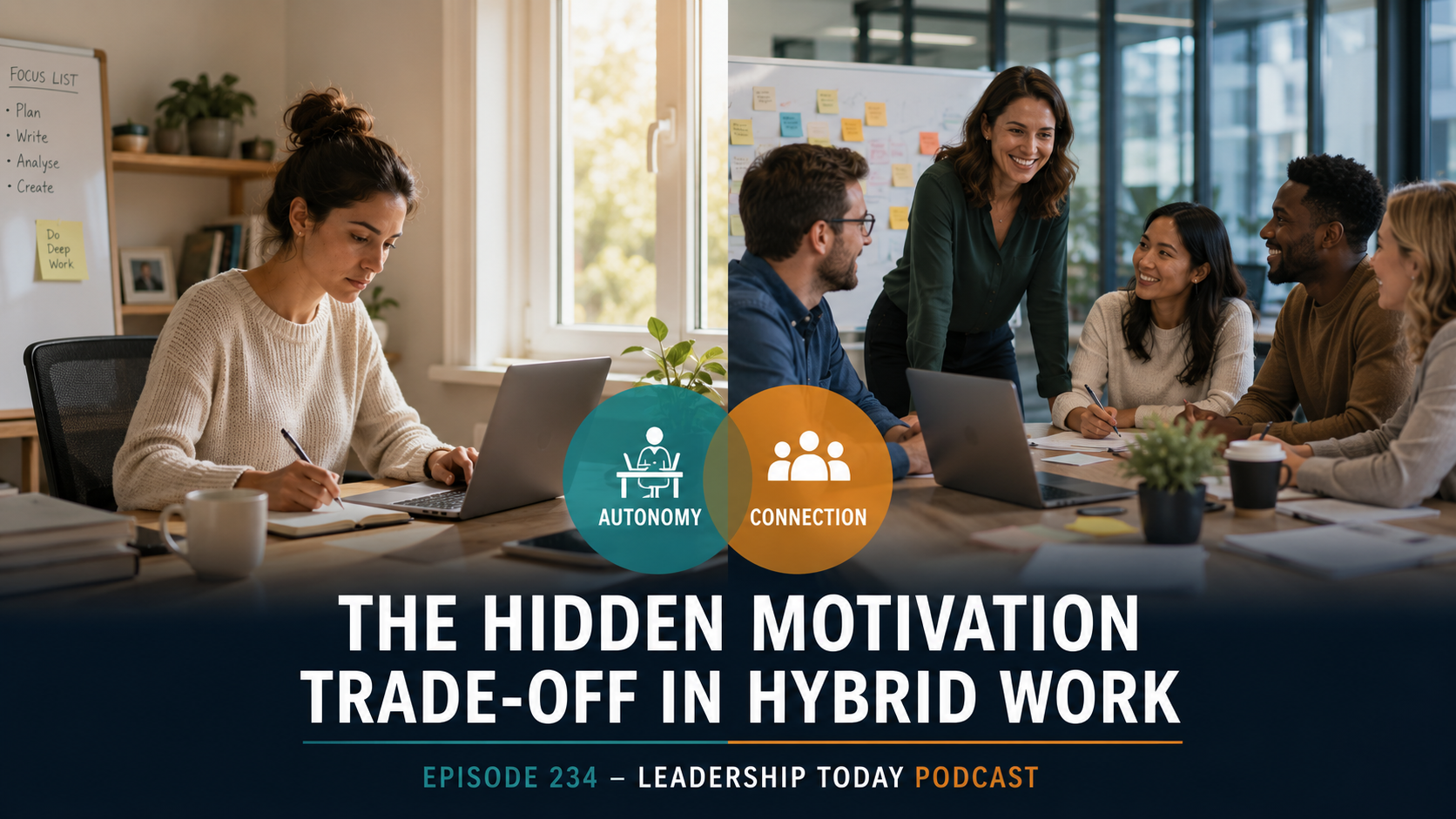
Hybrid work isn't simply about where people are most productive. New research shows that working remotely tends to satisfy our need for autonomy, while office days strengthen our sense of connection, with both playing a vital role in sustaining motivation. Rather than debating attendance, effective leaders intentionally design office days for collaboration and relationship building, and remote days for focused, independent work.
Summary
Hybrid work isn't simply about where people are most productive. New research shows that working remotely tends to satisfy our need for autonomy, while office days strengthen our sense of connection, with both playing a vital role in sustaining motivation. Rather than debating attendance, effective leaders intentionally design office days for collaboration and relationship building, and remote days for focused, independent work.
Transcript
Hello and welcome to episode 234 of the Leadership Today podcast, where each week we share practical tips to improve your leadership. This week we look at the hidden motivation trade-off in hybrid work.
The debate about hybrid work often comes down to a single question: where are people most productive? Are they better off working from home or in the office?
While that's an understandable question, new research suggests it may not be the most helpful one. Instead of asking where people work best, perhaps we should be asking which psychological needs are being met in each environment.
A recent diary study published in the European Journal of Work and Organizational Psychology followed 187 employees over ten working days, collecting almost 3,000 daily observations. Rather than simply measuring productivity or job satisfaction, the researchers looked at three fundamental psychological needs identified in Self-Determination Theory: autonomy, competence and relatedness.
Autonomy is our need to feel we have choice and control over our work. Competence is our need to feel capable and effective. Relatedness is our need to feel connected to other people. These three needs are important because they underpin high-quality motivation. When they're met, people are more likely to feel engaged, energised and willing to contribute. When they're frustrated, motivation tends to become more controlled, draining and less sustainable. The findings paint a much more nuanced picture of hybrid work than many headlines suggest.
On remote workdays, employees experienced greater autonomy. They felt they had more control over how they structured their work and, importantly, they maintained their energy better throughout the day. The researchers found that this greater sense of autonomy was associated with lower declines in energy during the afternoon and evening. However, there was a trade-off.
On office days, employees experienced greater relatedness. They felt more connected to the people around them. While office work didn't provide the same autonomy benefits, it did satisfy an equally important psychological need to belong.
This suggests that the question isn't whether remote work is better than office work, or vice versa. Each environment appears to support different aspects of motivation. For leaders, this changes the conversation. Rather than arguing about how many days people should be in the office, we should be asking what each day is designed to achieve.
If someone comes into the office simply to spend eight hours attending virtual meetings with headphones on, they've probably lost much of the autonomy of working from home without gaining the connection that office work can provide. Likewise, if someone works remotely every day without meaningful interaction, they may enjoy greater independence but gradually lose the sense of belonging that helps teams perform well over time. The best hybrid leaders think less about attendance and more about purpose.
Office days should be designed around the activities that benefit most from human connection. Coaching conversations, creative problem-solving, mentoring, relationship building, onboarding new team members and tackling complex issues together are all likely to benefit from being face-to-face.
Remote days, on the other hand, can be protected for focused work, thoughtful analysis, writing, planning and tasks that benefit from uninterrupted concentration and greater flexibility.
This research also reminds us that motivation isn't like one bucket that we are either filling or depleting. Motivation is shaped by the environment leaders create. We influence motivation every time we decide how work is organised, how meetings are scheduled and how much choice people have over the way they complete their work.
There are three practical areas you can consider this week.
First, look at your team's calendar. Are office days genuinely designed around collaboration and connection, or are people simply working alone in a different location?
Second, think about remote work. Are people given enough autonomy to benefit from working remotely, or have online meetings gradually filled every available hour?
Finally, ask your team a simple question: "When do you feel most energised during your working week?" Their answers may tell you far more than another debate about office attendance.
The key takeaway is that hybrid work isn't primarily a location challenge. It's a motivation design challenge. Remote work tends to support autonomy. Office work tends to support connection. Great leaders understand that both needs matter, and they intentionally design work so their people experience the benefits of each.
As always the reference we used is in the show notes. If you did enjoy this episode, please take a few moments to rate and review it on your preferred podcast player - that helps others to find it. Have a great week.
Reference
Olafsen, A. H., Kujanpää, M., Stenling, A., Tafvelin, S., & Bentzen, M. (2026). Daily need experiences across office and remote workdays. European Journal of Work and Organizational Psychology.
Leadership Today On-Demand Special Offer
We have a great deal for podcast listeners on our Leadership Today On-Demand subscription. Just go to www.leadershiptoday.com and checkout using the promo code PODCAST for 25% off an annual subscription.
Leadership Today On-Demand is a video subscription service that allows you to work on your leadership in your own time and at your own pace. It is available online and through our Apple iOS and Android apps for phones and tablets. Our mission is to help you to become an even better leader.
Your subscription brings together all of our video content in one place including:
- Five online courses with workbooks
- Five five day challenges with workbooks
- Nineteen recorded webinars
- A searchable library of 170+ "how to" quick videos on a range of leadership challenges
That's over $4,500 of content for less than the price of a single online course. And there are more videos added each week.
Get Connected
Find out ways to get connected here: https://leadership.today/connect

Episode 233 - Bored, Busy and Burned Out
Being busy does not protect people from boredom, and boredom does not mean someone has spare capacity. New research shows employees can be bored and burned out at the same time. This episode explores how role conflict, limited autonomy and poorly designed work create this combination, and what leaders can do about it.
Summary
Being busy does not protect people from boredom, and boredom does not mean someone has spare capacity. New research shows employees can be bored and burned out at the same time. This episode explores how role conflict, limited autonomy and poorly designed work create this combination, and what leaders can do about it.
Transcript
Hello and welcome to the Leadership Today podcast, where each week we share practical tips to improve your leadership. In this episode we explore whether it’s possible to be both bored and burned out, and what that means for us at work.
We often think of boredom and burnout as opposites. A bored employee does not have enough to do, while a burned-out employee has far too much. One needs more work and the other needs less. But new research suggests that this neat distinction does not reflect how people actually experience work. Research shows it is possible to be extremely busy and still be bored. It is also possible to be both bored and burned out at the same time.
A recent longitudinal study examined different profiles of boredom, burnout and work engagement. Rather than assuming every employee fell somewhere on a simple line from disengaged to engaged, the researchers found several distinct combinations. Some people experienced the familiar pattern of high burnout and low engagement. Others experienced boredom and burnout together.
At first, that may sound contradictory. But think about a person whose day is packed with repetitive tasks, constant interruptions, unclear priorities and unnecessary administration. They may be exhausted by the volume and fragmentation of the work while also feeling under-stimulated by its content. They have too much to do, but it still doesn’t feel challenging, meaningful or worthwhile.
That is one reason simply reducing workload may not solve every wellbeing problem. Managing workload matters enormously, but the design and quality of the work matter too. The research found that role conflict predicted less favourable wellbeing profiles. When people face incompatible expectations or competing priorities, they expend significant energy without necessarily experiencing progress or purpose.
By contrast, autonomy, learning opportunities and cognitive demands were associated with healthier wellbeing patterns. Cognitive demands do not mean overwhelming people with complexity. They involve providing enough challenge to keep work interesting and engaging.
There are three practical implications for leaders from this research:
First, don’t just look at workload alone. Someone can have a full calendar and an overflowing task list while still feeling deeply under-challenged. Ask not only, “How much work do you have?” but also, “Which parts of your work are energising or stretching you?”
Second, reduce role conflict. Clarify priorities when expectations compete. If everything is urgent, people can spend enormous amounts of energy shifting between demands without feeling they have accomplished anything meaningful. Leaders add value by deciding what matters most.
Third, increase healthy challenge and autonomy. Look for opportunities to give people ownership, involve them in problem-solving, rotate responsibilities or build new skills. The goal is not to add more tasks - it is to create better work.
It is also worth paying attention to mixed signals. A person who appears disengaged may not lack motivation. They may be depleted by the wrong kind of demands. Someone who asks for more challenging work may not have spare capacity. They may be looking for work that feels more worthwhile than the tasks currently exhausting them.
The takeaway is that wellbeing is not simply about how hard people work. It is also about what they are working on, how much control they have and whether the work provides clarity, learning and meaning. Great leaders do not just manage the quantity of work. They improve its quality.
As always the reference used in this podcast is in the show notes. Have a great week.
Reference
Toscanelli, C., Parmentier, M., Urbanavičiūtė, I., & Hirschi, A. (2026). The dynamics of well-being at work: Longitudinal profiles of boredom, burnout, and work engagement. European Journal of Work and Organizational Psychology. Advance online publication. https://doi.org/10.1080/1359432X.2026.2699462
Leadership Today On-Demand Special Offer
We have a great deal for podcast listeners on our Leadership Today On-Demand subscription. Just go to www.leadershiptoday.com and checkout using the promo code PODCAST for 25% off an annual subscription.
Leadership Today On-Demand is a video subscription service that allows you to work on your leadership in your own time and at your own pace. It is available online and through our Apple iOS and Android apps for phones and tablets. Our mission is to help you to become an even better leader.
Your subscription brings together all of our video content in one place including:
- Five online courses with workbooks
- Five five day challenges with workbooks
- Nineteen recorded webinars
- A searchable library of 170+ "how to" quick videos on a range of leadership challenges
That's over $4,500 of content for less than the price of a single online course. And there are more videos added each week.
Get Connected
Find out ways to get connected here: https://leadership.today/connect

Episode 232 - How To Lead With Humility
Humility is often overlooked as a leadership strength, yet research links it to higher trust, engagement, creativity, and performance. Learn why humility is far more than being nice and discover practical ways to demonstrate confidence, openness, and a willingness to learn.
Summary
Humility is often overlooked as a leadership strength, yet research links it to higher trust, engagement, creativity, and performance. Learn why humility is far more than being nice and discover practical ways to demonstrate confidence, openness, and a willingness to learn.
Transcript
Hello and welcome to episode 232 of the Leadership Today podcast, where each week we share practical tips to improve your leadership.
When we think about great leadership, humility isn't always the first quality that comes to mind. We often focus on confidence, vision, decisiveness, or influence. Yet some of the most effective leaders demonstrate humility. They don't pretend to have all the answers, they're quick to recognise the contributions of others, and they're always learning.
It turns out that humility isn't just a nice leadership quality, it has a measurable impact on how people experience their leader.
Two recent research reviews back this up. The larger paper brought together 212 separate studies on leader humility and found that, above everything else, humble leadership predicts how satisfied people are with their leader and how much leaders involve others in decisions. It also improves how well teams and individual followers perform. A second review, of 53 studies covering more than 16,000 people found humble leadership is linked to stronger trust, deeper engagement, greater job satisfaction, more creativity, and better performance at the individual level.
The second review also answered a question that's followed humility research for a while: is this just transformational leadership, servant leadership, or ethical leadership wearing a different name? The answer, in large part, was no. Humility contributed something beyond those other styles when predicting how people think and feel about their work. It has its own distinct influence.
So what does humility look like in practice? Across this research, humble leaders share three things in common:
They have an accurate understanding of their own strengths and limitations
They genuinely appreciate the strengths and contributions of others, and
They're open to feedback, learning, and changing their views when presented with new information.
In other words, humility isn't thinking less of yourself, it’s having an accurate view of yourself while recognising that others have valuable perspectives and capabilities too.
So what can leaders do to develop greater humility?
First, become comfortable saying "I don't know" or "I was wrong". Many leaders worry that admitting uncertainty will undermine their credibility. In reality, people often trust leaders more when they're honest about what they know and what they don't know. It also creates an environment where others feel safe to admit mistakes, ask questions, and learn.
Second, give credit generously. When someone on your team contributes an idea, solves a problem, or helps achieve a result, make sure people know where the contribution came from. It's a simple habit, but it sends a powerful message that leadership isn't about personal recognition, it’s about helping others succeed. And when people feel their contributions are noticed and valued, they're more likely to continue contributing.
Third, regularly seek feedback from the people around you. One simple question is, "What's something I do that gets in the way of you doing your best work?" The key is not just asking the question, but listening carefully to the answer. Resist the urge to explain or defend. Instead, thank the person for their feedback, reflect on what you've heard, and look for opportunities to improve.
The key point is that humility isn't weakness. it’s not a lack of confidence, and it's certainly not about downplaying your strengths. Humility is having the confidence to recognise that you don't have all the answers and that other people have valuable insights to contribute. People are more willing to trust, engage with, and follow leaders who are continuing to learn and grow.
Have a great week.
Research references
Chandler, J. A., Johnson, N. E., Jordan, S. L., Brian, D. K., & Short, J. C. (2023). A meta-analysis of humble leadership: Reviewing individual, team, and organizational outcomes of leader humility. The Leadership Quarterly, 34(1), 101660. https://www.sciencedirect.com/science/article/abs/pii/S1048984322000637
Luo Y, Zhang Z, Chen Q, Zhang K, Wang Y, Peng J. (2022) Humble leadership and its outcomes: A meta-analysis. Front Psychol. 2022 Dec 21;13:980322. doi: 10.3389/fpsyg.2022.980322. PMID: 36619057; PMCID: PMC9811147.
Leadership Today On-Demand Special Offer
We have a great deal for podcast listeners on our Leadership Today On-Demand subscription. Just go to www.leadershiptoday.com and checkout using the promo code PODCAST for 25% off an annual subscription.
Leadership Today On-Demand is a video subscription service that allows you to work on your leadership in your own time and at your own pace. It is available online and through our Apple iOS and Android apps for phones and tablets. Our mission is to help you to become an even better leader.
Your subscription brings together all of our video content in one place including:
- Five online courses with workbooks
- Five five day challenges with workbooks
- Nineteen recorded webinars
- A searchable library of 170+ "how to" quick videos on a range of leadership challenges
That's over $4,500 of content for less than the price of a single online course. And there are more videos added each week.
Get Connected
Find out ways to get connected here: https://leadership.today/connect

Episode 231 - Preparing for an Underperformance Conversation: The CLEAR Framework
Underperformance conversations often go wrong before they even begin. In this episode, we explore the CLEAR framework to help leaders prepare with greater clarity, curiosity and confidence. You’ll learn how to clarify the purpose, listen well, explore causes, agree on next steps and reinforce progress after the conversation.
Summary
Underperformance conversations often go wrong before they even begin. In this episode, we explore the CLEAR framework to help leaders prepare with greater clarity, curiosity and confidence. You’ll learn how to clarify the purpose, listen well, explore causes, agree on next steps and reinforce progress after the conversation.
Transcript
Hello and welcome to episode 231 of the Leadership Today podcast where each week we share practical tips to improve your leadership. This week we look at how to prepare for an underperformance conversation.
Most leaders think the hardest part of a performance conversation is the conversation itself. In my experience the hardest part is often the period beforehand. It’s the days or weeks spent thinking about the conversation, worrying about how the other person might react and wondering whether you’re approaching the situation in the right way.
I’ve noticed that when leaders describe a performance conversation that went badly, the problem rarely started in the conversation itself. More often, the leader entered the discussion without enough clarity. They hadn’t fully thought through what they wanted to achieve. They weren’t clear on the evidence they wanted to discuss. They hadn’t considered the other person’s perspective. And because they weren’t prepared, they became reactive when the conversation didn’t unfold exactly as expected.
What’s interesting is that the conversations we avoid are often the conversations that would help the most. A performance issue continues. Team members become frustrated. Standards start slipping. The leader becomes increasingly concerned. Yet the conversation keeps getting postponed because it feels uncomfortable. Unfortunately, avoidance doesn’t make the issue smaller. It usually makes it larger.
By the time the conversation finally happens, something else has often occurred as well. The leader has spent weeks carrying the emotional weight of the issue. They’ve replayed examples in their mind. They’ve built up frustration. They’ve developed assumptions about why the problem exists. In some cases, they’ve already decided what the other person thinks before they’ve even had the discussion. That’s why preparation matters so much.
Douglas Stone in his work on difficult conversations, suggests that these conversations become challenging when the stakes matter, views differ and emotions are involved. That combination exists in almost every performance discussion. The goal of preparation isn’t to eliminate those factors. The goal is to help us navigate them more effectively.
One framework that is particularly useful is CLEAR. The framework provides a simple structure for thinking about a conversation before it happens. It doesn’t give you a script to follow. Instead, it helps you clarify your thinking so you can enter the conversation with confidence, curiosity and purpose.
The first step is Context. Before you think about what you want to say, it’s worth asking yourself why you’re having the conversation in the first place. What is the purpose? What outcome are you hoping to achieve? What would success look like? Many leaders focus immediately on the problem. They begin preparing examples, evidence and arguments. While those things matter, starting with the problem can create a mindset where the goal becomes proving a point. A more useful approach is to start with the outcome. If the conversation goes well, what will be different afterwards? For example, perhaps you want someone to understand the impact of their behaviour on others. Perhaps you want them to improve a particular aspect of performance. Perhaps you want to understand what obstacles are getting in the way of success. Clarifying the purpose helps shape everything that follows.
The second step is Listen. This is where many leaders struggle because we’ve often spent so much time thinking about our perspective that we forget to explore theirs. When leaders describe performance conversations that went unexpectedly well, one of the most common reasons is that they learned something they didn’t know beforehand. The person revealed challenges, concerns or circumstances that completely changed how the leader understood the situation. Listening doesn’t mean agreeing. It doesn’t mean lowering expectations. It simply means recognising that there may be information you don’t yet have. Questions such as, “How do you think things have been going?”, “What’s been most challenging recently?” or “How do you see the situation?” create opportunities for insight. Sometimes the other person is already aware of the issue and has been struggling with it for some time. Sometimes they have a completely different interpretation of events. Either way, listening helps ensure the conversation is based on understanding rather than assumption.
The third step is Explore. This is where we move from symptoms to causes. We have previously discussed clarity, capability, confidence, and motivation. The Explore stage is where those concepts become useful. Rather than assuming you already know why the issue exists, you start investigating possible explanations. Perhaps the person lacks a particular skill. Perhaps they’re uncertain about expectations. Perhaps they’re experiencing personal challenges. Perhaps they’ve lost confidence after a setback. Perhaps they’re doing acceptable work but have stopped growing. The key is curiosity. Many leaders approach performance conversations believing they need to diagnose the problem before entering the room. A better approach is to enter the room with hypotheses rather than conclusions. Be willing to test your assumptions and adjust your thinking based on what you learn.
The fourth step is Agree. Once both perspectives have been explored and the likely causes are becoming clearer, it’s time to discuss what happens next. This is where vague commitments can become a problem. Statements such as “I’ll try harder”, “I’ll do my best” or “We’ll keep an eye on it” sound positive, but they rarely create lasting change because nobody is clear about what success actually looks like. Effective agreements are specific. What will change? What actions will be taken? What support will be provided? How will progress be measured? When will you check in again? The more specific the agreement, the greater the likelihood of improvement. Clarity reduces confusion and creates accountability.
The final step is Reinforce. Many leaders treat the conversation as the finish line when it should really be viewed as the starting point. Most meaningful performance improvement occurs after the conversation. People need encouragement, support and accountability. They need opportunities to discuss progress and obstacles. They need recognition when they improve and guidance when they struggle. Without reinforcement, even a strong conversation can lose momentum. With reinforcement, a difficult conversation can become the catalyst for genuine growth.
Running through all five stages is one underlying principle: curiosity. The most productive conversations are often those where the leader creates the conditions for understanding to emerge. Rather than delivering a verdict, they facilitate a discussion. Rather than proving a point, they explore possibilities. Rather than solving the problem alone, they work with the other person to identify a path forward. That’s why preparation matters so much. Good preparation doesn’t help you control the conversation. It helps you enter the conversation with greater clarity, confidence and curiosity.
This week, think about a performance conversation you need to have. Spend ten minutes working through the CLEAR framework. Clarify the context, identify questions you want to ask, think about what you need to explore, consider what agreement might look like and decide how you’ll reinforce progress afterwards. You may find that the conversation feels significantly less daunting once you’ve taken the time to prepare properly.

Episode 230 - Diagnosing Underperformance: Why Good People Underperform
Underperformance is often treated as a motivation problem when the real issue may be a lack of clarity, capability or confidence. Effective leaders resist the temptation to jump to conclusions and instead focus on understanding what’s driving performance. By diagnosing before prescribing, asking better questions and creating clear expectations, leaders can prevent many performance issues before they occur.
Summary
Underperformance is often treated as a motivation problem when the real issue may be a lack of clarity, capability or confidence. Effective leaders resist the temptation to jump to conclusions and instead focus on understanding what’s driving performance. By diagnosing before prescribing, asking better questions and creating clear expectations, leaders can prevent many performance issues before they occur.
Transqcript
Hello and welcome to episode 230 of the Leadership Today Podcast, where each week we share practical tips to improve your leadership. This week we explore four areas that will help you to diagnose likely performance issues before they become a problem.
When someone in our team starts underperforming, it’s remarkable how quickly we jump to conclusions. We see missed deadlines, lower quality work, reduced initiative or declining engagement and often assume we already know what’s going on. They must have lost motivation. They’ve become complacent. They don’t care as much as they used to. Before long, we’ve developed a story about the cause of the problem, often with very little evidence.
One of the biggest mistakes leaders make when managing performance is assuming they know why someone is underperforming. We observe behaviour and immediately start interpreting it. The challenge is that while behaviour is visible, the causes behind that behaviour are often hidden. Two people can display exactly the same performance issue for completely different reasons.
I was recently facilitating a workshop on managing underperformance and asked participants to think about someone in their team whose performance wasn’t where they wanted it to be. The leaders could easily describe what they were seeing. They talked about missed deadlines, lower quality work, avoidance of difficult tasks, reduced initiative and a general drop in engagement. What was much harder was identifying why those behaviours were occurring. As the discussion unfolded, it became clear that most leaders were highly confident about the symptoms but far less certain about the causes.
A useful way to think about performance is through four questions. Does the person know what good performance looks like? Can they do it? Do they believe they can do it? And do they want to do it? These questions point us towards four common drivers of performance: clarity, capability, confidence and motivation. Understanding which of these is getting in the way is often the difference between solving a problem and making it worse.
For example, someone may avoid a task because they weren’t aware it was important. Another might avoid it because they genuinely don’t have the skills or experience to complete it effectively. Another person may avoid exactly the same task because they’re worried they’ll fail or look incompetent. Another person may avoid it because they simply don’t see personal value in the task and have disengaged from the outcome. From the outside, all three situations can look identical. We see avoidance, hesitation or procrastination. What we don’t immediately see is the reason behind it.
This is why curiosity is such an important leadership skill. Rather than asking, “What’s wrong with this person?”, effective leaders ask, “What’s getting in the way of this person’s success?” That subtle shift moves us away from judgement and towards understanding. It encourages us to gather information before reaching conclusions and significantly improves our chances of providing the support people actually need.
Research provides some useful insights here. Self-Determination Theory, developed by Edward Deci and Richard Ryan, suggests that people are more likely to be motivated when three psychological needs are met: competence, autonomy and relatedness. Competence is the feeling that we can do something well. Autonomy is having some choice and control over our work. Relatedness is feeling connected to others and to a broader purpose. What’s particularly interesting is that competence sits at the foundation. When people don’t feel capable, motivation often suffers as a result.
Think about a time when you were asked to do something that felt completely outside your comfort zone. Perhaps you were asked to present to a large audience, lead a major project or take responsibility for something you’d never done before. Chances are you didn’t immediately feel highly motivated. You may have procrastinated, delayed getting started or looked for reasons to avoid the task. Someone observing your behaviour might have concluded that you lacked motivation. In reality, the issue may have been capability, confidence or both.
The same thing happens in our teams. Leaders often assume a motivation problem when the real issue is capability or confidence. The reverse can happen as well. Sometimes leaders invest heavily in training and development when the real issue is that someone no longer feels connected to the purpose of their work. Without understanding the cause, we’re simply guessing.
Another contributor to underperformance that often gets overlooked is clarity. Many performance issues begin long before performance actually declines. They start when expectations are vague, inconsistent or poorly communicated. I’ve worked with leaders who were frustrated that team members weren’t demonstrating enough initiative, only to discover that nobody had clearly defined what initiative actually looked like. Different leaders had different expectations, making it almost impossible for people to consistently succeed.
It’s difficult to hit a target you can’t clearly see. People are far more likely to perform well when they understand what success looks like, how their work contributes to broader goals and what standards are expected of them. Sometimes what appears to be an accountability issue is really an expectations issue. The conversation that needs to happen isn’t about performance correction. It’s about performance clarity.
So what can we do as leaders? First, diagnose before you decide. When you notice a performance issue, resist the temptation to immediately label it as a motivation problem. Consider whether the issue might relate to clarity, capability, confidence or motivation. Gather information before reaching conclusions.
Second, ask better questions. Questions such as “What’s been most challenging about this?” or “What support would help you succeed?” often reveal far more than assumptions ever will. The quality of our diagnosis depends heavily on the quality of our questions.
Third, focus on prevention rather than correction. The best underperformance conversation is often the one you never need to have because expectations were clear from the beginning. Invest time upfront defining success, checking understanding and providing regular feedback before problems emerge.
Managing underperformance can be one of the most challenging aspects of leadership, but it becomes much easier when we replace assumptions with curiosity. Most people don’t come to work intending to underperform. More often, something is getting in the way of their success. Our role as leaders is to understand what that obstacle is and help remove it.
This week, think about someone whose performance isn’t where you’d like it to be and ask yourself four questions: Do they know what good looks like? Can they do it? Do they believe they can do it? Do they want to do it? Your answers may completely change the conversation you need to have.

Episode 229 - How To Re-engage A 'Quiet Quitter'
Quiet quitting isn’t usually about laziness or a lack of motivation. Research suggests it’s often a sign that the relationship between an employee and their organisation has become unbalanced. Discover how leaders can spot the warning signs early and rebuild engagement through better conversations and clearer expectations.
Summary
Quiet quitting isn’t usually about laziness or a lack of motivation. Research suggests it’s often a sign that the relationship between an employee and their organisation has become unbalanced. Discover how leaders can spot the warning signs early and rebuild engagement through better conversations and clearer expectations.
Transcript
Hello and welcome to episode 229 of the Leadership Today podcast, where each week we share practical tips to improve your leadership. This week we explore how to re-engage a “quiet quitter”.
Over the past few years, you’ve probably heard the term “quiet quitting” - the idea that some people are stepping back from their roles to just do the bare minimum. It’s one of those phrases that quickly gained popularity and sparked plenty of debate. Some people viewed it as a sign that employees had become less committed. Others saw it as a healthy rejection of unrealistic work expectations.
But the important question is what causes someone who was once engaged, enthusiastic, and willing to go the extra mile to start doing only the minimum required in the first place? Recent research suggests the answer has less to do with motivation and more to do with relationships and fairness.
Researchers studying quiet quitting have found that one of the strongest predictors is employees’ perceptions of the exchange relationship they have with their organisation. In simple terms, people compare what they’re contributing with what they’re receiving in return. When they feel the relationship has become unbalanced and they don’t see a way to improve it, they often respond by reducing their discretionary effort. Importantly, this doesn’t necessarily mean they’re planning to leave. Instead, they adjust their level of investment. They continue to do their job, but they stop contributing the extra effort that often drives innovation, collaboration, and performance.
The research also points to an important leadership influence. Teams whose leaders maintain regular conversations about both work and wellbeing appear less likely to experience quiet quitting. In other words, leaders who stay connected with their people are often better able to identify and address issues before disengagement takes hold. So what can you do to reduce the risk of quiet quitting?
First, have open conversations about expectations. Work relationships involve an ongoing exchange. What is the employee contributing? What are they receiving in return? Have either of those things changed recently? These discussions can sometimes uncover relatively small issues that, if left unaddressed, gradually erode engagement.
Second, make sure your one-on-one meetings cover more than just tasks and deadlines. It’s important to understand how people are feeling about their role, what’s energising them, and what’s becoming frustrating or difficult. These conversations often provide early warning signs that someone may be disengaging.
Third, if you notice a drop in effort or enthusiasm, get curious rather than critical. It’s tempting to focus on the behaviour itself. However, quiet quitting is often a symptom rather than the problem. Understanding what has changed is usually more productive than immediately trying to correct the behaviour.
The key point is that quiet quitting is rarely about laziness. More often, it’s a signal that something in the relationship between the employee and the organisation has shifted. As leaders, we may not be able to solve every issue, but we can create the conversations that help us understand what’s really going on. And often, that’s the first step towards rebuilding engagement.
Have a great week.
Research references:
Galanis, P., et al. (2023). The quiet quitting scale: Development and initial validation. AIMS Public Health, 10(4), 828 to 848. https://pmc.ncbi.nlm.nih.gov/articles/PMC10764970/
Dilchert, S., et al. (2026). Expanding Our Understanding of Quiet Quitting: Antecedents, Correlates, and Consequences. Human Resource Management. https://onlinelibrary.wiley.com/doi/10.1002/hrm.70038
Leadership Today On-Demand Special Offer
We have a great deal for podcast listeners on our Leadership Today On-Demand subscription. Just go to www.leadershiptoday.com and checkout using the promo code PODCAST for 25% off an annual subscription.
Leadership Today On-Demand is a video subscription service that allows you to work on your leadership in your own time and at your own pace. It is available online and through our Apple iOS and Android apps for phones and tablets. Our mission is to help you to become an even better leader.
Your subscription brings together all of our video content in one place including:
- Five online courses with workbooks
- Five five day challenges with workbooks
- Nineteen recorded webinars
- A searchable library of 170+ "how to" quick videos on a range of leadership challenges
That's over $4,500 of content for less than the price of a single online course. And there are more videos added each week.
Get Connected
Find out ways to get connected here: https://leadership.today/connect

Episode 228 - How To Get The Best From AI Without Falling Off The Edge
AI can be incredibly helpful, but it’s not always right. Learn about the “jagged frontier” of AI capability and why the most effective leaders know when to rely on AI and when human judgement remains essential. Discover practical ways to get the benefits of AI without falling into its traps.
Summary
AI can be incredibly helpful, but it’s not always right. Learn about the “jagged frontier” of AI capability and why the most effective leaders know when to rely on AI and when human judgement remains essential. Discover practical ways to get the benefits of AI without falling into its traps.
Transcript
Hello and welcome to episode 228 of the Leadership Today podcast, where each week we share practical tips to improve your leadership. In this episode we explore the so-called “jagged frontier” of Artificial Intelligence - where we fail to apply human judgement and pay the price.
If you’ve been using AI for a while, you’ve probably had two very different experiences. Sometimes it feels almost magical. It helps you generate ideas, summarise information, improve your writing, and solve problems faster than you thought possible. Then there are those other moments. The answer sounds convincing, looks professional, and is completely wrong.
Understanding why that happens is becoming one of the most important leadership skills of our time.
A study involving more than 750 consultants at Boston Consulting Group explored the impact of using GPT-4 on a range of consulting tasks. The results were impressive. People completed more work, worked faster, and generally produced higher-quality outputs when using AI. But the researchers uncovered something equally important. When participants used AI on tasks that were beyond the technology’s capabilities, their performance actually became worse. The AI didn’t simply fail to help. It often led people towards the wrong answer.
The researchers described this as the “jagged frontier” of AI. Some tasks sit comfortably within AI’s capabilities and the benefits can be substantial. Other tasks sit just beyond that frontier. The challenge is that AI often sounds equally confident in both situations. That’s why the biggest risk with AI isn’t that it makes mistakes. Humans make mistakes too. The risk is that we stop applying our own judgement because the answer looks so polished and convincing. So what can leaders do?
First, identify where AI genuinely adds value in your work. Think about the tasks where it consistently helps you save time, generate ideas, improve communication, or increase quality. Just as importantly, identify the situations where you’ve seen it get things wrong. Understanding both sides of the equation helps you use AI more effectively.
Second, keep your judgement in the process. For important decisions, strategic thinking, or complex problem-solving, consider forming your own view before turning to AI. Even a few notes or bullet points can help you avoid being overly influenced by the first answer AI provides.
Third, have open conversations with your team about how they are using AI. Some tasks may be suitable for handing over largely to the technology. Others require people to stay actively involved, challenging assumptions and validating outputs along the way. The more explicit you are about these differences, the better the outcomes are likely to be.
The key point is that AI is neither a miracle solution nor something to be feared. It’s a powerful tool with strengths and limitations. The leaders who get the greatest benefit won’t be those who use it for everything - they’ll be the ones who learn where it performs best and where human judgement remains essential.
Have a great week.
Research reference: Dell'Acqua, F., et al. (2023). Navigating the Jagged Technological Frontier: Field Experimental Evidence of the Effects of AI on Knowledge Worker Productivity and Quality. Harvard Business School Working Paper 24-013. https://papers.ssrn.com/sol3/papers.cfm?abstract_id=4573321
Leadership Today On-Demand Special Offer
We have a great deal for podcast listeners on our Leadership Today On-Demand subscription. Just go to www.leadershiptoday.com and checkout using the promo code PODCAST for 25% off an annual subscription.
Leadership Today On-Demand is a video subscription service that allows you to work on your leadership in your own time and at your own pace. It is available online and through our Apple iOS and Android apps for phones and tablets. Our mission is to help you to become an even better leader.
Your subscription brings together all of our video content in one place including:
- Five online courses with workbooks
- Five five day challenges with workbooks
- Nineteen recorded webinars
- A searchable library of 170+ "how to" quick videos on a range of leadership challenges
That's over $4,500 of content for less than the price of a single online course. And there are more videos added each week.
Get Connected
Find out ways to get connected here: https://leadership.today/connect

Episode 227 - How to Use Microbreaks to Restore Focus
Feeling exhausted despite being busy all day? Research suggests that short breaks throughout the day can boost energy, reduce fatigue, and help sustain performance. Discover how leaders can use microbreaks more effectively and encourage healthier work habits across their team.
Summary
Feeling exhausted despite being busy all day? Research suggests that short breaks throughout the day can boost energy, reduce fatigue, and help sustain performance. Discover how leaders can use microbreaks more effectively and encourage healthier work habits across their team.
Transcript
Hello and welcome to episode 227 of the Leadership Today podcast, where each week we share practical tips to improve your leadership. This week we’re exploring how to use microbreaks to restore focus.
Have you ever reached the end of a day and wondered why you’re exhausted despite never really stopping? Many leaders spend their day moving from meeting to meeting, email to email, task to task, without taking a genuine break. We often assume that pushing through is a sign of commitment and productivity. But there comes a point where working longer doesn’t mean working better.
It turns out that even very short breaks can make a difference.
A 2022 review of more than 20 studies found that microbreaks, breaks of less than ten minutes, help boost energy levels and reduce fatigue. In other words, those small pauses throughout the day aren’t wasted time. They’re one of the ways we sustain performance over the longer term.
The researchers also found an important limitation. Microbreaks help maintain energy, but they aren’t a substitute for proper recovery. If you’ve spent two hours doing deep analysis, solving complex problems, writing a major report, or making difficult decisions, a five-minute break will help, but it won’t completely restore you. Some work requires a more substantial break. That’s why lunch breaks, time away from work, and good recovery outside of work still matter.
So what can leaders do?
First, build short breaks into your day before you feel exhausted. Most of us wait until our energy is gone before stepping away. A better approach is to take a brief break every 60 to 90 minutes. Stand up, walk around, grab a drink, stretch, or simply look away from your screen for a few minutes. The goal is to create a genuine mental shift, even if it’s only for a short period of time.
Second, match your work to your energy. Try to schedule your most demanding work when you’re feeling fresh. Save routine tasks, administration, and email for periods when your energy is naturally lower. Too often we do the opposite, spending our best hours reacting to other people’s priorities and leaving our most important work until we’re already mentally depleted.
Third, role model healthy habits. Teams often take their cues from their leader. If you’re working through lunch, responding to emails late at night, and sitting at your desk all day, others may feel pressure to do the same. When leaders take sensible breaks and openly manage their energy, they give others permission to do likewise.
The key point is that performance isn’t just about how hard we work. It’s also about how well we recover. Small breaks won’t solve everything, but they can help us maintain our energy, focus, and effectiveness throughout the day. Sometimes the most productive thing you can do next is step away for a few minutes.
Have a great week.
Research reference: Albulescu, P., et al. (2022). "Give me a break!" A systematic review and meta-analysis on the efficacy of micro-breaks for increasing well-being and performance. PLOS ONE, 17(8), e0272460. https://journals.plos.org/plosone/article?id=10.1371/journal.pone.0272460
Leadership Today On-Demand Special Offer
We have a great deal for podcast listeners on our Leadership Today On-Demand subscription. Just go to www.leadershiptoday.com and checkout using the promo code PODCAST for 25% off an annual subscription.
Leadership Today On-Demand is a video subscription service that allows you to work on your leadership in your own time and at your own pace. It is available online and through our Apple iOS and Android apps for phones and tablets. Our mission is to help you to become an even better leader.
Your subscription brings together all of our video content in one place including:
- Five online courses with workbooks
- Five five day challenges with workbooks
- Nineteen recorded webinars
- A searchable library of 170+ "how to" quick videos on a range of leadership challenges
That's over $4,500 of content for less than the price of a single online course. And there are more videos added each week.
Get Connected
Find out ways to get connected here: https://leadership.today/connect

Episode 226 - How to Reduce Loneliness at Work
One in five people feel lonely at work. While loneliness is often seen as a personal issue, research suggests leaders play a bigger role than they might realise in helping people feel connected, included, and supported.
Summary
One in five people feel lonely at work. While loneliness is often seen as a personal issue, research suggests leaders play a bigger role than they might realise in helping people feel connected, included, and supported.
Transcript
Hello and welcome to episode 226 of the Leadership Today podcast, where each week we share practical tips to improve your leadership.
Most of us think of loneliness as something that happens outside of work. But Gallup’s latest global research found that around one in five workers feel lonely at work.
Workplace loneliness isn’t just about how people feel - research shows it’s linked to higher burnout, lower performance, more sick leave, and greater turnover. In fact, loneliness can be just as damaging to performance as job dissatisfaction.
A recent review published in Occupational Medicine found that one of the strongest workplace factors associated with lower loneliness is leadership. Leaders who are supportive, approachable, and empowering help create an environment where people feel connected and valued.
Now, leaders can’t solve every cause of loneliness. People bring their own circumstances, personalities, and experiences to work. But we can influence whether work becomes a place where people feel connected or isolated.
Here are three practical ways to help.
First, make genuine connection part of your regular conversations. Before jumping into tasks and deadlines, spend a minute asking how someone is going and really listen to the answer. People often don’t need a solution. They just need to know someone is interested.
Second, pay attention to inclusion. Most people don’t feel excluded during formal meetings. They feel excluded from the conversations before and after them. Notice who gets invited into informal discussions, brainstorming sessions, and problem-solving conversations. Small moments of inclusion often have a bigger impact than large team-building activities.
Third, be deliberate with hybrid work arrangements. People can easily become disconnected when their work patterns don’t overlap with the rest of the team. Sometimes a simple conversation about coordinating office days can dramatically improve connection and collaboration.
The key point is this. Loneliness at work isn’t simply a personal issue - it’s often a leadership issue. Every interaction either strengthens or weakens someone’s sense of belonging. As leaders, we have more influence over that than we might think.
Have a great week.
Research reference: Wright, J. K., et al. (2024). Loneliness in the workplace: a mixed-method systematic review and meta-analysis. Occupational Medicine, 73(9), 557 to 567. https://academic.oup.com/occmed/article/73/9/557/7591258
Leadership Today On-Demand Special Offer
We have a great deal for podcast listeners on our Leadership Today On-Demand subscription. Just go to www.leadershiptoday.com and checkout using the promo code PODCAST for 25% off an annual subscription.
Leadership Today On-Demand is a video subscription service that allows you to work on your leadership in your own time and at your own pace. It is available online and through our Apple iOS and Android apps for phones and tablets. Our mission is to help you to become an even better leader.
Your subscription brings together all of our video content in one place including:
- Five online courses with workbooks
- Five five day challenges with workbooks
- Nineteen recorded webinars
- A searchable library of 170+ "how to" quick videos on a range of leadership challenges
That's over $4,500 of content for less than the price of a single online course. And there are more videos added each week.
Get Connected
Find out ways to get connected here: https://leadership.today/connect